
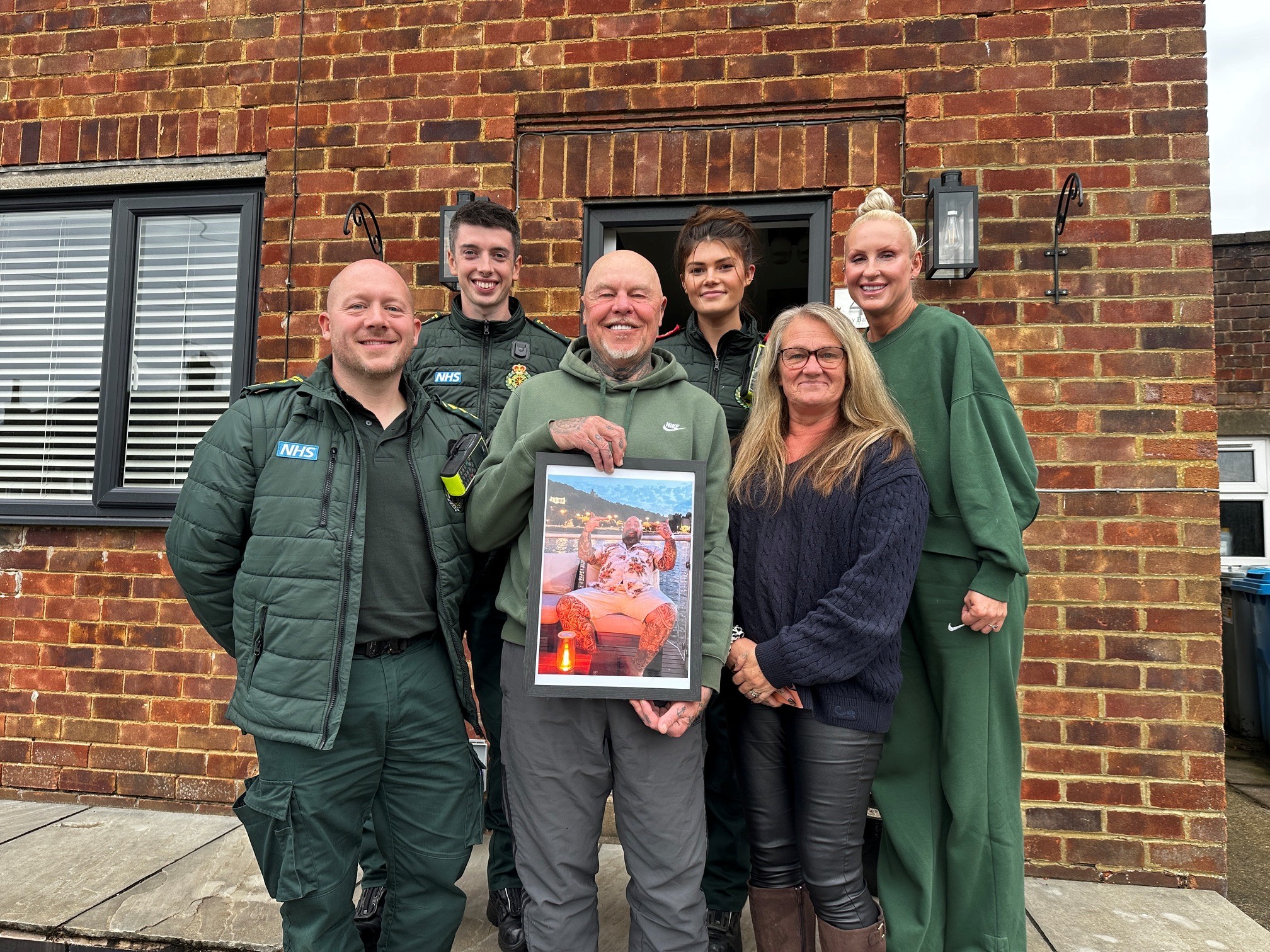
A Northamptonshire man who suffered a cardiac arrest at home has met with the East Midlands Ambulance Service crew who helped to save his life.
Martin Wishart, from Rothwell, was 55 when he suffered a cardiac arrest in January 2022, after experiencing chest pains and a racing heartbeat in the days beforehand.
At the time, Martin was working as a scaffolder and living with atrial fibrillation (AF), a condition that causes an irregular and often abnormally fast heart rate.
He said:
"On the Friday before, I wasn't feeling well. I had chest pains and my heart was beating fast, but I carried on working."
Two days later, Martin went out for a meal with his then girlfriend, Shereen. Still feeling unwell, he decided to return home early ahead of work the following morning.
However, his chest pain and racing heartbeat continued.
Martin said:
"I called Shereen later and asked what the number was for non-emergency medical help because the chest pain was still there and my heart was beating fast, which was causing me to panic.
"That's the last thing I remember."
Martin had also called his friend Dan, who arrived within minutes and found him unresponsive and without a pulse.
Dan immediately called 999 and with guidance from the EMAS call handler, began Cardiopulmonary Resuscitation (CPR) while waiting for an ambulance to arrive.
Martin said: “Dan worked in one of the local pubs at the time and it felt like fate that he answered my call. If he hadn’t and tried to call me back later, I probably wouldn’t be here anymore.”
Sadly, Dan has since passed away, but Martin will forever be grateful to his friend for rushing to him and saving his life.
He said: “I didn’t even know that Dan knew how to do CPR! He was a man of incredible intelligence and skills, but the most important thing to me and my family is that he knew what to do when I collapsed.”
As Dan fought to save Martin’s life, the crew of Duty Commander Samuel Sears, Associate Divisional Clinical Leader James Macdonald, Specialist Practitioner Anna Leitch and Emergency Care Assistant Gareth Clark headed to the scene.
On arrival, crews instructed Dan to continue CPR while they while they prepared the equipment needed to treat Martin. As Martin’s cardiac arrest happened during the COVID-19 pandemic, the crew were also required to work while wearing enhanced protective equipment.
The crew continued Martin's treatment, performing prolonged CPR and delivering 12 shocks from a defibrillator. He later suffered another cardiac arrest and required further CPR before he was stable enough to be taken to hospital.
On arrival, Martin was placed into an induced coma as he experienced organ failure.
He was initially brought out of the coma on 20 January but was extremely confused and delirious, so he was sedated again for a further couple of days.
For his family, who were unable to be at his bedside because of the COVID restrictions in place at the time, it was an incredibly worrying period.
Martin said:
"My family were called for a meeting while I was in a coma. Because of the amount of time I hadn't been breathing, they didn't know whether I would have brain damage or even whether I would survive.
"It had a massive impact on my family. It was very scary for them, particularly because they couldn't see me in hospital or sit with me because of the COVID rules.
"Every time the phone rang, they worried it was going to be bad news."
Shereen said:
“All I could do was stand at the door and watch Martin lie in his bed. It was so upsetting to not be sat by his side, telling him he would get through this.”
The odds were stacked against Martin, however against them all, he continued to recover.
On 7 February, he had an implantable cardioverter defibrillator (ICD) fitted. The small device monitors the heart's rhythm and can deliver treatment if it detects a dangerous heart rhythm.
Martin was discharged home the following day, but there was a long way to go in his recovery.
He said:
"Shereen had to become not only my girlfriend but a full-time carer because I couldn't do anything for myself.
"I still had pain from the broken ribs caused by CPR and was very weak and unstable on my legs, which left me virtually bedbound.
"I couldn't drive or work for six months, but I was just grateful to be alive and back home."
Looking back, Martin admits his lifestyle at the time was also having a serious impact on his health.
"At the time I was a functioning alcoholic and addicted to cocaine, which wasn't a good thing as I suffer with AF.
“My cardiac arrest forced me to change my life drastically. I haven't touched cocaine since that night and I don't drink every night anymore.
"After everything that happened, I'm just grateful to still be here.
“I thought I was invincible, but things can change in an instant. I hope other people see my story who may be in the same position I was and decide that it is time for them to change their lives too.”
Since his cardiac arrest, Martin's ICD has activated once when his heart rate became dangerously high, delivering two shocks to restore his heart rhythm. He was taken to hospital afterwards for monitoring and blood tests.
Martin said:
"The ICD doesn't cause me any issues and enables me to carry on with a normal life. It gives me peace of mind that if my heart was ever to go into another cardiac arrest, the ICD is there.
"For me, there are far more pros than cons to having it fitted."
More than four years on, Martin remains enormously grateful to everyone who played a part in giving him that a second chance at life.
Martin said:
"I owe so many people my life. I would just like to say a massive thank you to the EMAS crew and hospital staff who helped save my life and also to the call handler who gave Dan help and guidance while he was waiting for the ambulance to arrive."
Lesley, Martin’s current partner said:
“I know it has been Martin’s wish for a long time to meet the crew and I am so pleased we have been able to make it happen. He turns 60 in November and we are going to have a big party to celebrate. The reason we can do that is because of the amazing people we have been lucky enough to meet from EMAS and Dan, who working together, saved Martin.”
Samuel Sears, Duty Commander said:
“It has been great to meet Martin after all this time and see how well he is doing. We knew it was touch and go when we initially attended him all that time ago, so to hear he has turned his life around is brilliant.”
Dan's willingness to act, call 999 and begin CPR meant lifesaving treatment had already started before ambulance crews arrived.
Learning CPR means you could be ready to act if somebody suffers a cardiac arrest at home, at work or in your community. Those first few minutes can make a crucial difference.
Visit the Community Trainer section of our website to book a free one-hour training session with our volunteers and learn lifesaving CPR and how to use an Automated External Defibrillator (AED).