
When patients need support travelling to or from hospital for important appointments, a team of dedicated people at EMAS make those journeys possible.
Our Non-Emergency Patient Transport Service (NEPTS) supports eligible patients who do not need an emergency ambulance but their medical condition or injury means they need extra support while travelling to or from hospital.
In these situations, a dedicated team at EMAS ensures that patients can reach their destination safely.
 The team providing non-emergency transport to eligible patients
Our NEPTS crews provide care and transport in Derbyshire, Lincolnshire and Northamptonshire. They often travel across the country to help patients safely get to where they need to be – whether that’s taking them home after being discharged from hospital, or to hospital for treatment or an appointment.
Behind the scenes in our operations centre, another part of the team books and coordinates the journeys – they liaise with patients, hospitals and NEPTS crews to make it happen.
Together, the NEPTS team helps thousands of patients every year to reach the right care in the right place.
Supporting patients at all stages of their lives
Beth Williams joined EMAS as a NEPTS Controller and Planner in May 2025. It’s her role to make sure journeys are planned efficiently so that patients can get to their appointments and return home safely.
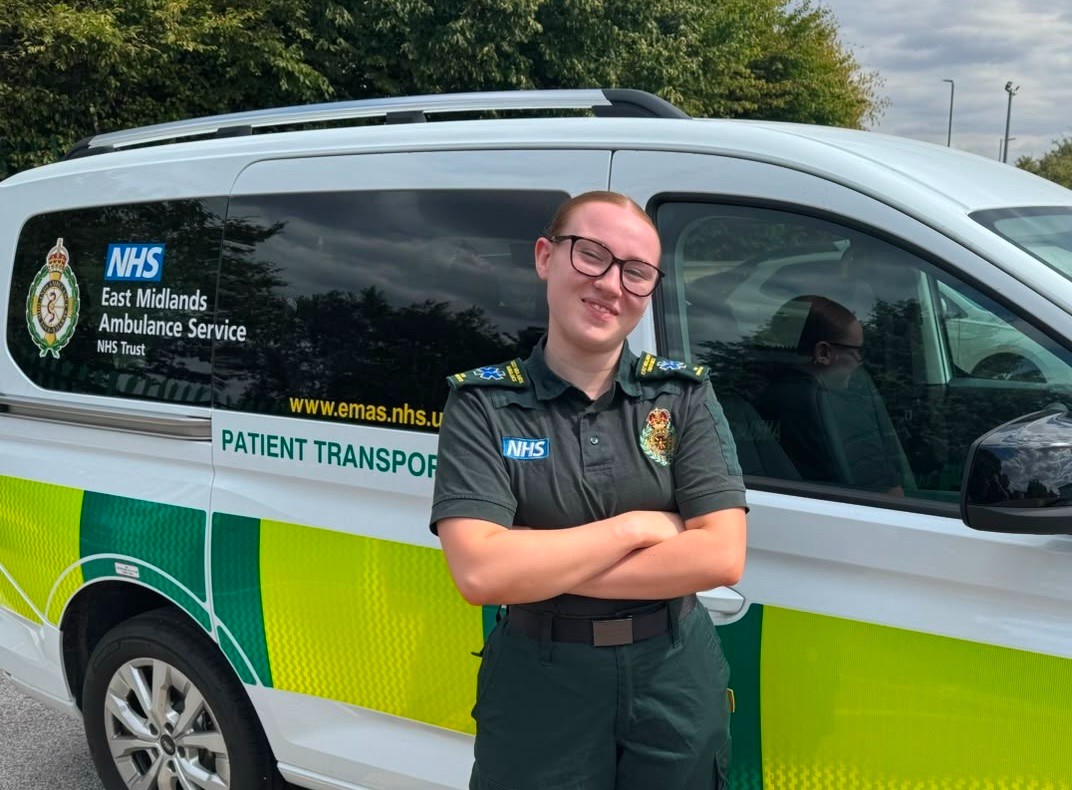 Beth sees the positive impact of her work every day.
She explains: “At NEPTS, we’re here for patients at some of the most difficult times of their lives. For instance, taking people to their renal dialysis or chemotherapy appointments and then home again.”
“We’re also involved in every stage of life. If a premature baby needs to be taken via emergency ambulance to a hospital neonatal unit, NEPTS can support by transporting the mother too – we try to time it so she can travel closely behind her baby. Being part of those journeys is a special privilege.”
“Sometimes we’re tasked with taking patients from hospital to pass peacefully at home, in accordance with their wishes – it’s a real honour to be involved in that last journey. Like all journeys, it’s about making sure the patient reaches their destination safely and with dignity.”
Beth’s path to the ambulance service
Beth grew up with two parents in the ambulance service. Her mum started her career as a 999 call taker, and her stepdad was a technician.
“I grew
up in the ‘green family’ – it’s in my blood. From a young age I knew I wanted a career in the ambulance service. University wasn’t for me but I knew I could get the skills and experience I needed by going a different way.”
Beth began by volunteering as a St John Ambulance cadet at 14. She then gained her Level 3 qualification in First Response Emergency Care. She joined EMAS a day after her eighteenth birthday.
She explains: “You don’t need to go to university to start a career in the ambulance service. Volunteering for St John helped me gain valuable skill and experience. I’d encourage anyone interested in a career in the service to explore volunteering opportunities – there are lots of options out there.”
The role of NEPTS in supporting patient care
Beth is passionate about the role that NEPTS plays in patient care, the ambulance service, and the wider NHS.
“Not every career in the ambulance service starts with blue lights and sirens, but we’re all here for patients in their time of need.”
“I know our team makes a difference. Some of the patients we support are isolated and have no family nearby. Patients who we see regularly have told me that we’re like family to them – they look forward to seeing our crews. That’s really special.”
Opportunities to learn and develop
Beth hopes her story will help other people see the range of opportunities within the ambulance service.
“Every role at EMAS plays an important part in patient care, and there are many ways to build skills, progress and make a difference every day. Many people think the only way is to go straight to university and become a paramedic, but there are so many different routes into a rewarding career."
“As part of the NEPTS team, I’m developing my understanding of operations, non-emergency patient transport systems and NHS pathways. I work with lots of senior leaders at EMAS who started out in the patient transport service. This job gives you so many experiences and opportunities to learn and develop.”
“To do this job, like any other job in the service, you have to be willing to learn, listen, and grow. You also need resilience. No matter how challenging it can get, I keep thinking about the patient – I have the privilege of making a difference for them and making sure they’re safe.”
“Wherever my career in the ambulance service takes me, I know I’ll look back on my time in this role and be grateful for all the things I learned.”