
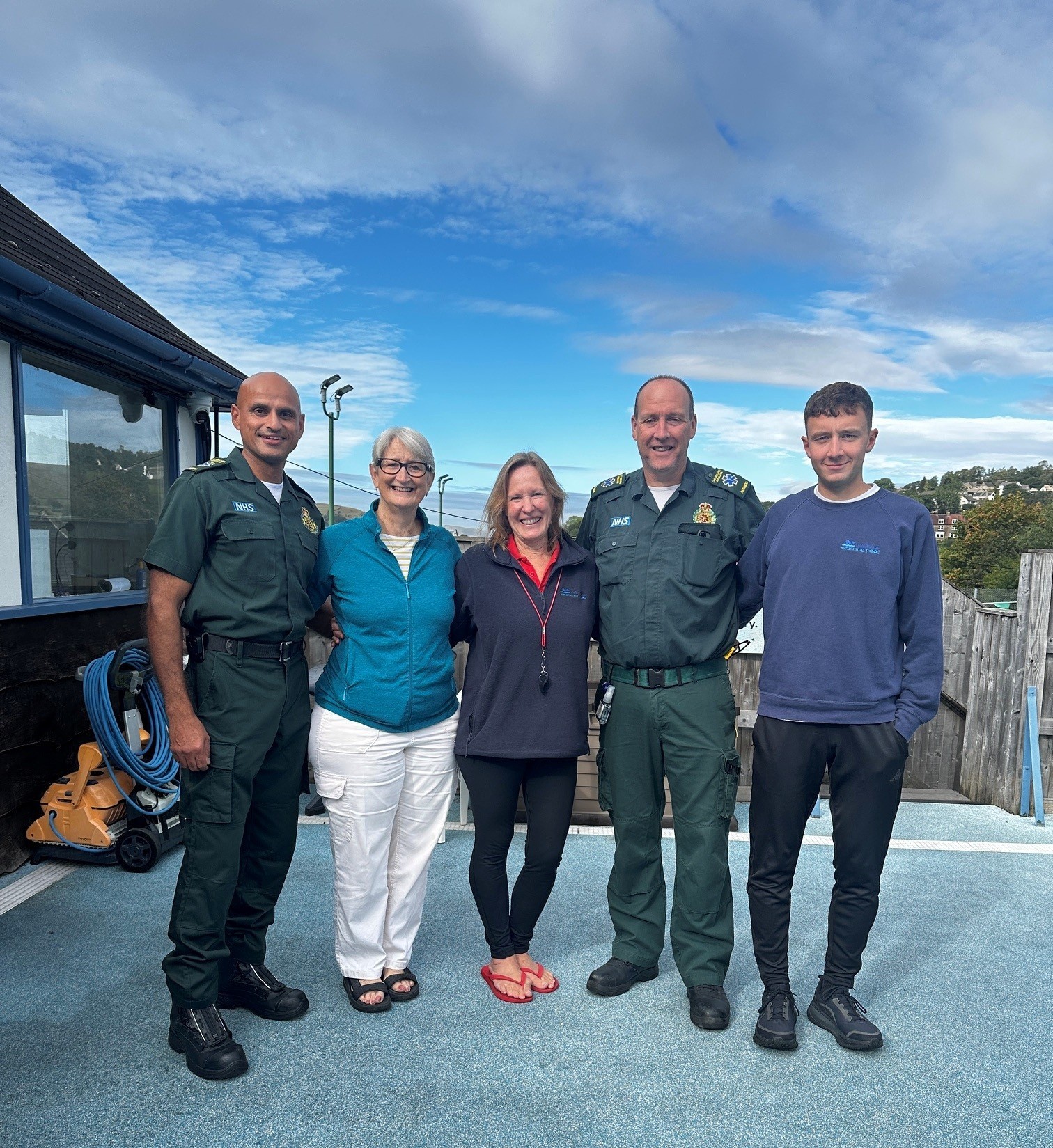
A Derbyshire grandmother who suffered a sudden cardiac arrest while swimming earlier this year, has today reunited with the East Midlands Ambulance Service crew and lifeguards who helped save her life.
Maggie Thurman, now 69, from Youlgrave, was 68 when she collapsed during one of her regular swimming sessions at Hathersage Swimming Pool on 26 January 2026.
Leading an active lifestyle, Maggie had no reason to suspect that anything serious was underlying and had no symptoms which led her to believe so.
On the morning of her cardiac arrest, she had picked up her friend Jane, who also lives in the village before the pair travelled to their usual swimming session.
Maggie said:
"I remember very little about the actual day. We'd had friends round for dinner the night before and I suppose I might have been tired.
"I picked Jane up at about 9.15am and we drove to Hathersage for our 10am swim. I don't remember anything about the swim itself, although one of the lifeguards later told me I dived in as usual."
From there, Maggie’s memory goes blank.
According to witnesses, Maggie managed to reach the side of the pool and cling on before beginning to sink beneath the water. Another swimmer quickly noticed something was wrong and held her above the surface until she could be pulled from the pool.
Immediately calling 999, Lifeguards Josh, Mary and Helen began Cardiopulmonary Resuscitation (CPR) on Maggie while the crew of Paramedics Nicholas Hinchley and Simon King and Technician Asad Khan made their way to the scene. They were quickly followed up by Critical Care Paramedic, Karl Bexon from The Air Ambulance Service.
Josh said:
"It is wonderful that a skill I learnt through my lifeguarding means that Maggie is sat here today with us, is back swimming and doing the things that she loves."
Helen said:
"It is a credit to the training that we have at the pool, that we knew immediately what to do and in some way, it felt like a scenario that had been put on for us to test our skills. It was like a reflex and we all just slotted into our roles instantaneously."
After continuous CPR and several shocks from a defibrillator, crews were able to achieve a Return of Spontaneous Circulation (ROSC) and stabilise Maggie so that she could safely be transported to Sheffield's Northern General Hospital, where she was taken for specialist treatment.
Ian, Maggie’s husband, received the call informing him what had happened from Jane while out walking and rushed to be by Maggie’s side.
The next few days remain largely a blur.
Maggie said:
"The next thing I remember is being in hospital, but even that is hazy. I have no recollection of the first few days, although apparently I was messaging friends.
"My son James and his wife Sally travelled from Bristol and my daughter Amy came from Manchester. It was a very scary time for them because I was still not out of the woods when they arrived."
Doctors carried out a series of investigations, including an angiogram, but found no blocked arteries, significant heart scarring or signs of heart failure.
Nine days after being admitted to hospital, Maggie had an implantable cardioverter defibrillator (ICD) fitted before returning home the following day.
While her recovery progressed well, the emotional impact the cardiac arrest had on her family took much longer to ease.
Maggie said:
"For the first few weeks my family were very nervous about me coming home, particularly my daughter, who felt I was safer in hospital.
"As time went on and I became stronger and less tired, they could see how well I was doing."
Maggie completed a cardiac rehabilitation programme and four months after her cardiac arrest, was excited to return to swimming.
She said:
"When I was allowed back in the water, I was thrilled. My family were not quite so pleased.”
Now, more than six months on, Maggie says she feels fitter and healthier than she did before her cardiac arrest.
Looking back on the life changing experience, Maggie is keen to highlight the importance of CPR and the crucial role played by the people who helped her that day.
Shortly after returning home, the Women's Institute in Youlgrave organised a CPR training session which had a strong attendance from local residents, including Maggie's husband.
Maggie believes the immediate CPR she received was critical to her recovery.
"Apparently the most important part of resuscitation is the CPR and my lifesavers were so good at it that I didn't suffer from hypoxia and therefore brain damage.
"I owe so much to the lifeguards, bystanders and the EMAS crew who acted so quickly. Without them, things could have turned out very differently.
"It is so lovely to be here to say thank you to everyone because obviously I don't remember anyone from that day and it really is very special for me. This reunion is a really good way for me to process what happened."
Nicholas said:
"It really is fantastic to see Maggie again. In 21 years, I don't think I have ever met a patient that I have previously looked after and we rarely get to know the outcome of those patients we help, so it really is nice to be here.
"Maggie's story is a brilliant reminder that CPR can save lives. On the day, the lifeguards were like a well oiled machine, doing excellent CPR which meant that when we arrived on scene, she only needed a couple of shocks before she was trying to sit up and talk to us."
Cardiac arrest can happen to anyone, anywhere and at any time. In the UK, fewer than one in ten people survive an out-of-hospital cardiac arrest.
Immediate CPR can more than double a person's chance of survival, while early access to a defibrillator can significantly improve outcomes.
Maggie's survival is a powerful reminder on how early intervention and effective CPR can make a significant difference when someone suffers a cardiac arrest.
Visit the Community Trainer section of our website to book a free one-hour training session with our volunteers. Learn life-saving CPR and how to use an Automated External Defibrillator (AED)—skills that could help you save a life.