
Exactly six months after collapsing on his way to work, bus driver Martin Chilton has been reunited with some of the ambulance colleagues who helped give him a second chance at life.
Martin, 56, suffered a cardiac arrest at Broadmarsh Bus Station in Nottingham on 11 May 2026. On 11 November, he and his wife Allyson Chilton met some of the EMAS colleagues involved in his care to thank them in person.
A young woman raised the alarm, and two passers-by began cardiopulmonary resuscitation (CPR), continuing until emergency help arrived.
Emergency Care Assistant Dan Hurst was among the ambulance colleagues who responded from EMAS. A paramedic in a solo response car was already at the scene when Dan and his crewmate arrived.
Dan said: “The most important thing was the CPR Martin received before we arrived. The people around him raised the alarm and started chest compressions within seconds.
“Those first few minutes after a witnessed cardiac arrest are crucial. Without people stepping forward and taking action, Martin’s outcome could have been very different.”
EMAS colleagues continued CPR and were able to get Martin’s heart beating again. However, his heart stopped again before colleagues were able to restart it and keep it beating.
Dan added: “We worked closely together and took turns giving chest compressions so we could keep the CPR going effectively.
“There was really good communication between everyone at the scene. We all knew our roles and were working towards the same goal, giving Martin the best possible chance.”
Medics from Lincs & Notts Air Ambulance also arrived by car to provide advanced care before Martin was taken to Nottingham City Hospital.
Martin’s wife Allyson was asleep at their home in Hucknall at the time, having recently returned from a night shift as a receptionist at Queen’s Medical Centre.
She said: “Martin was getting ready for work when I got home so we were like passing ships.
“I gave him a kiss goodbye. I went to bed and he went to work. There were no signs any of this was going to happen.”
At around 8.50am, Allyson received a call from a withheld number. She did not answer at first but picked up when they called again.
Allyson said: “They told me they were the police. At first, I thought it was my son because he rides a motorbike.
“Then they told me Martin had suffered a cardiac arrest. My legs just went to jelly.”
A police officer collected Allyson and took her to hospital. She arrived before Martin’s ambulance and was taken into a family room to wait for him.
She said: “When he arrived, I was told I had two minutes with him. I leant over him and said, ‘Don’t you dare die.’”
Martin remained critically ill and spent around a week in a medically induced coma. Allyson stayed at the hospital so she could remain close to him.
She was there when Martin began to regain consciousness and his breathing tube was removed.
Allyson said: “He started coughing and I spoke to him to keep him calm. Then he looked at me and said, ‘Sorry.’
“It literally broke me. Then he said, ‘Work.’ I reassured him that work knew what had happened.”
Martin has little memory of the day of his cardiac arrest.
He said: “For me it was ‘bang’ and I could not have been here. I didn’t even know it had happened.
“Things like that make you realise that it can all end as quickly as that. Had it not been for the young woman raising the alarm and the people doing CPR, I might not be here anymore.”
Martin has continued his recovery with support from a cardiac rehabilitation programme and returned to work in a non-driving role in September.
He said: “Work is a very important part of my life. I’m keen to get back.
“For now, my goal is to keep following the advice I’ve been given and concentrate on my recovery.”
At the reunion, Martin and Allyson met Emergency Care Assistant Dan Hurst and Duty Commander Alan Good. They talked about Martin’s recovery, and the couple were able to learn more about what happened that morning and how ambulance resources respond to emergencies.
Alan had attended Martin’s cardiac arrest as a cardiac arrest lead, a role which involves overseeing the scene, the patient’s care and treatments, and supporting decision-making during the resuscitation.
He said: “With Martin, it was quite a complicated resuscitation. We got him back and then we lost him again, and then we got him back again and managed to keep him back.
“It was then about making sure everything was done within the right timeframe to give Martin the best possible chance of a positive outcome.”
Meeting Martin again exactly six months later was a special moment for Alan.
He said: “It’s really rewarding to see Martin today. In more than 30 years with the ambulance service, I know lots of people I’ve treated have survived, but you don’t always have the opportunity to meet them again.
“When somebody like Martin comes back and wants to say thank you, it really does mean a lot.”
For Allyson, the reunion meant being able to fulfil the reason she originally contacted EMAS.
She said: “It means a lot. I don’t think ‘thank you’ seems enough. Everybody involved in Martin’s care has given him a second chance at life and, if it wasn’t for the care of the ambulance staff, he wouldn’t be here today.
“To meet some the team and to say thank you means a lot. The guys we’ve met today are absolutely amazing. They do their job, but their caring nature goes above and beyond.
“EMAS will always be our heroes, along with Lincs & Notts Air Ambulance Service.”
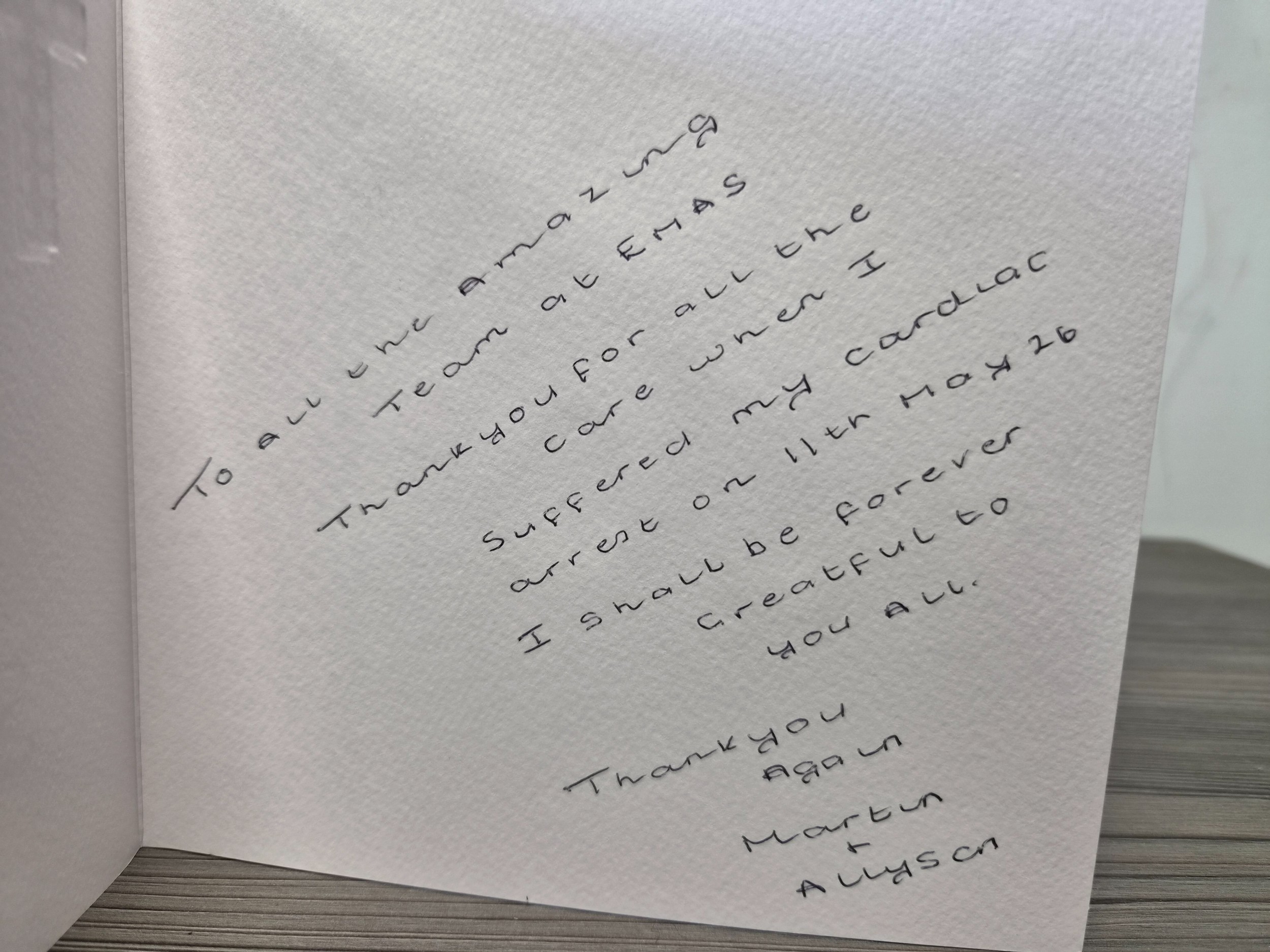
Martin and Allyson presented a Thank You card to Alan and Dan, who received it on behalf of everyone who responded to Martin that day. It reads:
"To all the amazing team at EMAS. Thank you for all the care when I suffered my cardiac arrest on 11th May 26.
"I shall be forever grateful to you all.
"Thank you again,
"Martyn and Allyson."