
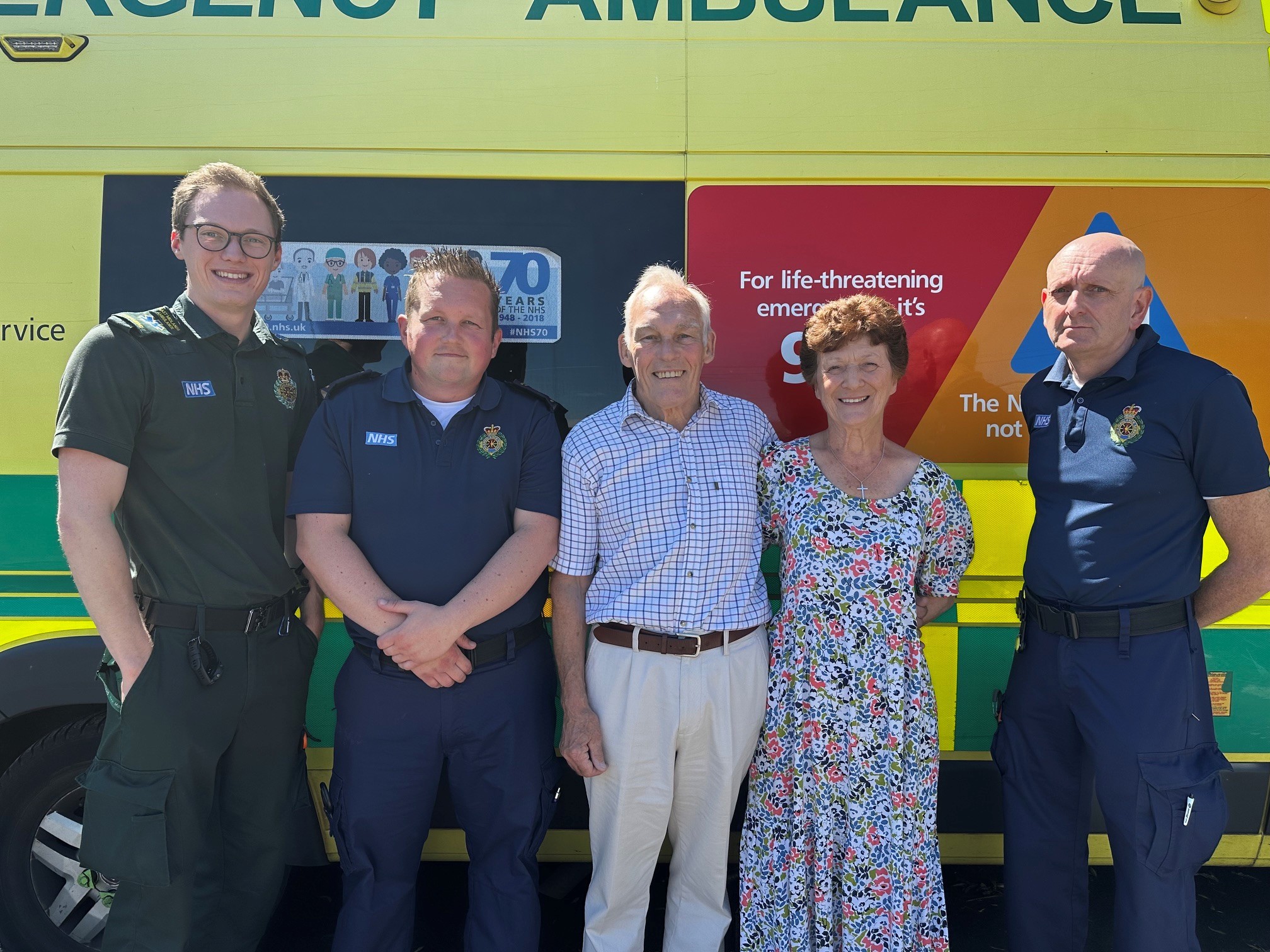
An EMAS Community First Responder from Leicestershire has today been reunited with the East Midlands Ambulance Service crew and volunteers who helped save his life after he suffered a sudden cardiac arrest in January 2026.
Peter Blount, 77, from Wymeswold in Loughborough, is no stranger to Cardiopulmonary Resuscitation (CPR), volunteering his time to help save the lives of others and train members of the public in CPR. In the early evening of 15 January however, Peter came to owe his life to the same skills he teaches.
Peter had been diagnosed with heart problems the previous year but otherwise considered himself in good health. He had no reason to suspect anything was wrong that day. Feeling completely normal in himself, he and his wife Lesley were heading to the cinema in Melton Mowbray.
After running back to the car to collect the tickets, Peter collapsed in the cinema right in front of Lesley and several cinema goers who were heading into the screens.
Peter said: “I had no reason to think that anything was wrong with me and next thing I knew, I was being told what happened by my wife. I have no memory of driving to the cinema or anything after 3pm that day. It now feels like someone else's story.”
What unfolded next is a perfect example of the ‘Chain of Survival’ in action. Lesley began CPR on Peter immediately, knowing that every second counted towards his survival. She was quickly joined by Adam, an off-duty fireman, staff from the cinema and a retired surgeon who supported her, with Adam jumping in to take over chest compressions.
Within minutes of the 999 call, local Community First Responders Tim Frisby and Jonny McGrady arrived on scene. They recognised Peter as one of their colleagues and stepped in to continue CPR.
Tim and Jonny were quickly followed up by EMAS crews – Duty Commander Neal McVeagh, Paramedics Catherine Warnes and Christopher Richards, and the Air Ambulance crew of Andy Mockridge and Samuel Cooper. By this time, nine people were working together to save Peter’s life.
Peter received three shocks from a defibrillator and was supported with oxygen for ten minutes. The crews and volunteers were working hard to stabilise him and achieve a Return of Spontaneous Circulation (ROSC). Once they knew Peter was safe to be transported, they travelled to Glenfield General Hospital on blue lights.
Peter said:
"The amazing thing is that I was at a place where kind, responsive people were and a defibrillator was also on hand. If I had collapsed at my car, I would not be here today."
Lesley added:
“I was standing beside Peter when he collapsed and when I couldn’t revive him by speaking to him or touching him, I knew what had happened, so I just knew I had to get on with it and start administering CPR.”
Peter woke in hospital the following morning, confused and with bruised ribs, listening to the story of his survival and trying to piece together what had happened. After a week in the care of hospital staff whom he describes as " wonderful," he was fitted with an implantable cardioverter-defibrillator (ICD) and returned home to recover.
"The early time at home was strange as I had never been ill before", he said. "I of course had lots of emotions, worries, aches and pains, but I was so glad to be alive."
Peter's survival carries a particular significance given his own history of helping others. For the past 14 years, his primary voluntary role as a Community First Responder and Group Coordinator for the Wolds Community Response Scheme has seen him work with EMAS crews on the frontline, working through Covid on the immunisation programme, and facilitating CPR training in schools and organisations.
Peter is also a Scout leader with the 1st Wolds Scout Group and is an active member in his local community. He organises the Annual Remembrance Day Parade and service each year and is an active member of the Wymeswold Men's Group. He also volunteers with the Wymeswold Duck Race.
His dedication to community service was formally recognised in 2025 when he was awarded the British Empire Medal (BEM). He also holds both the Queen's Medal and the King's Medal for his voluntary and frontline work with EMAS.
Before his cardiac arrest, Peter had an active life, playing rugby until he was 50 and never spending a single night in hospital.
Five months on, Peter has already resumed his role as an EMAS CPR trainer. In June 2026 alone, he trained over 100 people to save a life, adding to the estimated 2,000 people he has taught throughout his volunteering career. He is also returning to scouting and plans to get back in the saddle for some horse riding soon.
He said: “I am still a bit tired, but I am alive thanks to quick thinking and capable people.
“I would urge everyone to learn CPR and basic life support and get to know where your nearest AED is to your home. You can save a life."
For Peter and Lesley, meeting with the volunteers and crew was a chance for them to ask what they remembered about the day and how they felt seeing everything unfold.
Lesley praised the EMAS team and the bystanders for their help that day and said:
“There is no way on earth I can express my thanks, my gratitude and reward them for what they did. I just want to thank them so much for choosing to do this with their lives and they are very, very special people.”
Tim Frisby, Community First Responder and first on the scene to Peter, said:
“We followed the process, people came to help and we all worked as a team and Peter is back with his family. It is difficult to quantify what that means but it has been a fantastic thing to be part of and it is fantastic for EMAS to enable people in their communities to be involved in the saving of people's lives.
Christopher Richards, Paramedic, added:
“It is lovely to see a positive outcome and it is nice to see that what we do makes a huge difference to people’s lives and really has given Peter that second chance in his life.”
Cardiac arrest can happen anywhere, at any time. In the UK, fewer than one in ten people survive an out-of-hospital cardiac arrest. Immediate CPR can double or even triple chances of survival and every minute without intervention reduces those odds dramatically.
Learning CPR can make bystanders lifesavers when every second counts.
Visit the Community Trainer section of our website to book a free one-hour training session with our volunteers. Learn life-saving CPR and how to use an Automated External Defibrillator (AED) - skills that could help you save a life.
This week is Check Your Defib Week. A defib can only save a life if it’s ready.
If you are a Defibrillator Guardian, ensure your defibrillator status is updated on The Circuit. It takes minutes and could save a life.