
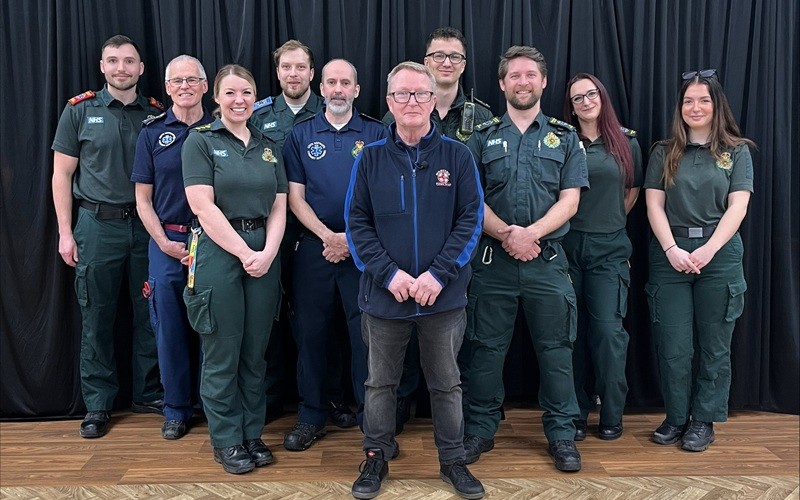
Left to Right: Thomas Matthews, Martin Fowler, Nicole DeLellis, Callum Nixon,Simon Crossley, Alan Grimes, Harry Tabberer, Philip Gouldie, Naomi Arnold and Millie Attfield
Staff from Wootton Primary School in Northamptonshire have reunited with the East Midlands Ambulance Service crew who saved their colleague's life. School caretaker Alan Grimes, 64, suffered a cardiac arrest at work on 11 June 2025.
Alan had felt unwell for days but dismissed it as being busy and feeling ‘a bit on and off’. While taking a break and eating breakfast, he collapsed and became unresponsive.
A team of colleagues rushed to help, recognising that something was wrong. Others quickly followed after hearing shouts for help.
One of the first on scene, Debbie Stacey, said, “I checked for danger and tried talking to Alan, but he only grunted. When he started to vomit, his colour changed and his breathing became irregular, I shouted for someone to call an ambulance.”
The call was answered by Emergency Medical Advisor Millie Attfield.
When the school’s First Aiders, Ceri Matthews and Kerry Godfrey, arrived moments later, they acted immediately.
Ceri said: “Both myself and Kerry arrived at the school kitchen, not really knowing what was going on other than that Alan was in the recovery position and making gurgling sounds.
“I knew immediately this was a sign his airway wasn’t open. We moved him onto his back, opened his airway, and I knew CPR and the defibrillator were needed straight away.
“Everything we’d been trained to do came flooding back. It proves that CPR and defibrillators save lives.”

Kerry Godfrey and Ceri Matthews with the defibrillator which helped save Alan's life
Kerry added: “I just went into automatic mode. Training kicked in and I knew we needed to act fast. As Ceri went to set up the defibrillator, I started chest compressions and then we shocked him. I continued the chest compressions, listening to the call handler on the phone. I just knew I needed to act.”
Following a GoodSAM alert, Community First Responders Simon Crossley and Martin Fowler rushed to help. They were soon joined by the crew of Divisional Senior Clinical Leader Nicole DeLellis, Paramedics Harry Tabberer and Philip Gouldie, Trainee Technician Callum Nixon, Specialist Practitioner Thomas Matthews and the air ambulance crew of Paramedic Mark Beasley and Doctors Arun George and Imogen Virgo.
Simon recognised Alan immediately.
He said: “I knelt down and realised it was Alan, the caretaker who greeted everyone in the mornings. I did a primary survey and asked the teacher to continue CPR since she was doing it well."
The crew worked to stabilise Alan and achieve a Return of Spontaneous Circulation (ROSC) before rushing him to Kettering General Hospital. Before leaving, clinicians told staff their fast actions had been critical in saving Alan’s life.
At the reunion, Simon emphasised to the teachers: “We got Alan breathing again because the whole process went smoothly. While we brought extra skills and equipment, Alan's chances would have been much lower if they hadn't reacted so quickly and professionally. Their help was key to his recovery.”
For many staff, it was emotional to hear that Alan had regained consciousness.
Kerry said: “When I heard he was alert and talking, that’s when I cried.”
Colleague Lisa Jackson added: “I’d never experienced anything like it. It was traumatic, especially because Alan is a friend. But I realised I played a part in saving his life.”
While Alan can’t recall what happened that morning, he remembers waking up in the hospital surrounded by loved ones.
He said: “My wife explained that I had a cardiac arrest and that I was talking gibberish. They put a stent in my heart.”
Alan spent three days in the hospital and recovered through August, returning to work in September 2025. His family had been very worried at first but he is doing well now.
“I encourage everyone to learn CPR and how to use a defibrillator. It saved my life.”
Tom Matthews, Specialist Practitioner said:
“It is amazing to see Alan here today looking so well after what happened. We couldn’t believe it when we heard he was back at work in September, just a couple of months after his cardiac arrest.
“As crew, we rarely get the chance to reunite with patients and for many of us today, this is the first time we have had that opportunity. It has been really special. Alan is one of only 8% of people who survive to discharge from hospital after suffering an Out of Hospital Cardiac Arrest and that is down to the CPR and defibrillation which was administered to him.”
Cardiac arrest can happen anywhere, at any time. In the UK, less than 1 in 10 people survive an Out of Hospital Cardiac Arrest. In 2024, there were 7,553 such calls in the East Midlands. Data shows that 81.9% of these cardiac arrests occurred at home, and 53.6% were witnessed by someone nearby.
Immediate CPR can double or even triple chances of survival. Every minute without CPR reduces survival rates, so bystander intervention is crucial. Learning CPR can make bystanders lifesavers when every second counts.
Visit the Community Trainer section of our website to book a free one-hour training session with our volunteers. Learn life-saving CPR and how to use an Automated External Defibrillator (AED) - skills that could help you save a life.