
After more than three decades serving communities across the East Midlands, Dave “Tuna” Turner, a founding member of the EMAS Hazardous Area Response Team (HART), has retired after 31 years of service – leaving behind a legacy defined by authenticity, courage, and an unwavering commitment to helping others.
Ask Dave how he’d introduce himself, and his answer is instant: “What you see is what you get.”
He prides himself on honesty, consistency, and treating everyone the same – whether he’s responding to a patient in their living room or spending time with his mum.
He says these values were instilled by his dad and grandad, and they have guided him throughout his life in uniform.
From the Royal Engineers to the ambulance service
Dave’s nickname, “Tuna”, has followed him since his Army days.
A talented goalkeeper, he earned the name from fellow squaddies who linked his surname, Turner, with Billy the Fish – a cartoon footballing goalkeeper from the magazine Viz.
Dave’s Army experience, and particularly his time as a Troop Medic, laid the foundations for a career in pre-hospital care.
He said: “When I left the Army after my initial service, I knew I wanted to stay in a job that was about helping people.”
Dave applied for the ambulance service, fire service, and police service – and was successful in all three interviews. Ultimately, it was the ambulance role that “felt right.”
Finding his footing in Patient Transport
Dave began his EMAS journey in 1994 in Patient Transport Services (PTS), based in Newark – something he describes as invaluable grounding.
He explained: “PTS taught me how to talk to people, understand different characters, and read a room.”
That ability to adapt to whatever situation he walked into would later become a vital skill in emergency care.
Dave progressed to Emergency Medical Technician and later became a registered paramedic in 2006 – a milestone he describes with pride – as it meant taking on a different set of clinical responsibilities while still working as part of a close, supportive team.
As he puts it: “You’re only ever as good as the team around you.”
Becoming one of the HART originals
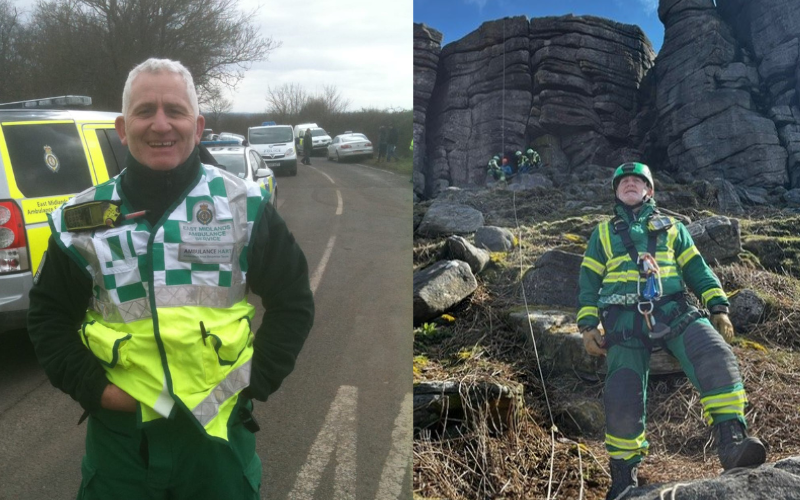
The formation of the Hazardous Area Response Team in 2008 marked a turning point, not just for EMAS, but for Dave personally.
Thinking back to major national incidents such as the King’s Cross Fire in 1987, and the London bombings of 2005, he saw the HART team as a crucial improvement in how EMAS responds to large-scale or complex emergencies.
As one of the original HART members when the team went live in 2009, Dave played a meaningful role in shaping its early identity.
Those first few months involved intense training and making sure the team could operate consistently and safely in challenging environments.
For Dave, the appeal was immediate:
“It had my name written all over it.
“We never hesitate to take on challenging situations when the emergency response calls for it.”
As a Team Leader from 2012, he worked hard to build a culture of openness, flexibility and psychological safety.
Dave added: “When you really know your team, you notice when someone isn’t quite themselves.
“When this happened, I’d take them aside, talk to them, and help in whatever way I could.
“I can put my hand on my heart and say I’ve done my best for people when they needed it.”
Not just a career
When asked what kept him going through 31 years of shifts, Dave said:
“It’s a calling. My family always said I was made for this.
“What makes me proud is knowing that somewhere across the region, especially at Christmas, there are families sitting around the table with loved ones who might not have been there if it wasn’t for the work my colleagues and I have done.”
Looking ahead
Away from the demands of emergency response, Dave has a creative side too – recently teaching himself to read music and play the saxophone, a challenge he approached with the same determination he brought to his clinical career.
Sid Murphy, HART and Special Operations Manager at EMAS said:
“Tuna’s retirement marks the end of a remarkable chapter for EMAS and the Hazardous Area Response Team.
“His authenticity, courage, and unwavering commitment to doing the right thing have made a lasting different to the service, his colleagues, and to countless patients across the region.
“Thank you, Dave, for 31 years of outstanding service.”