
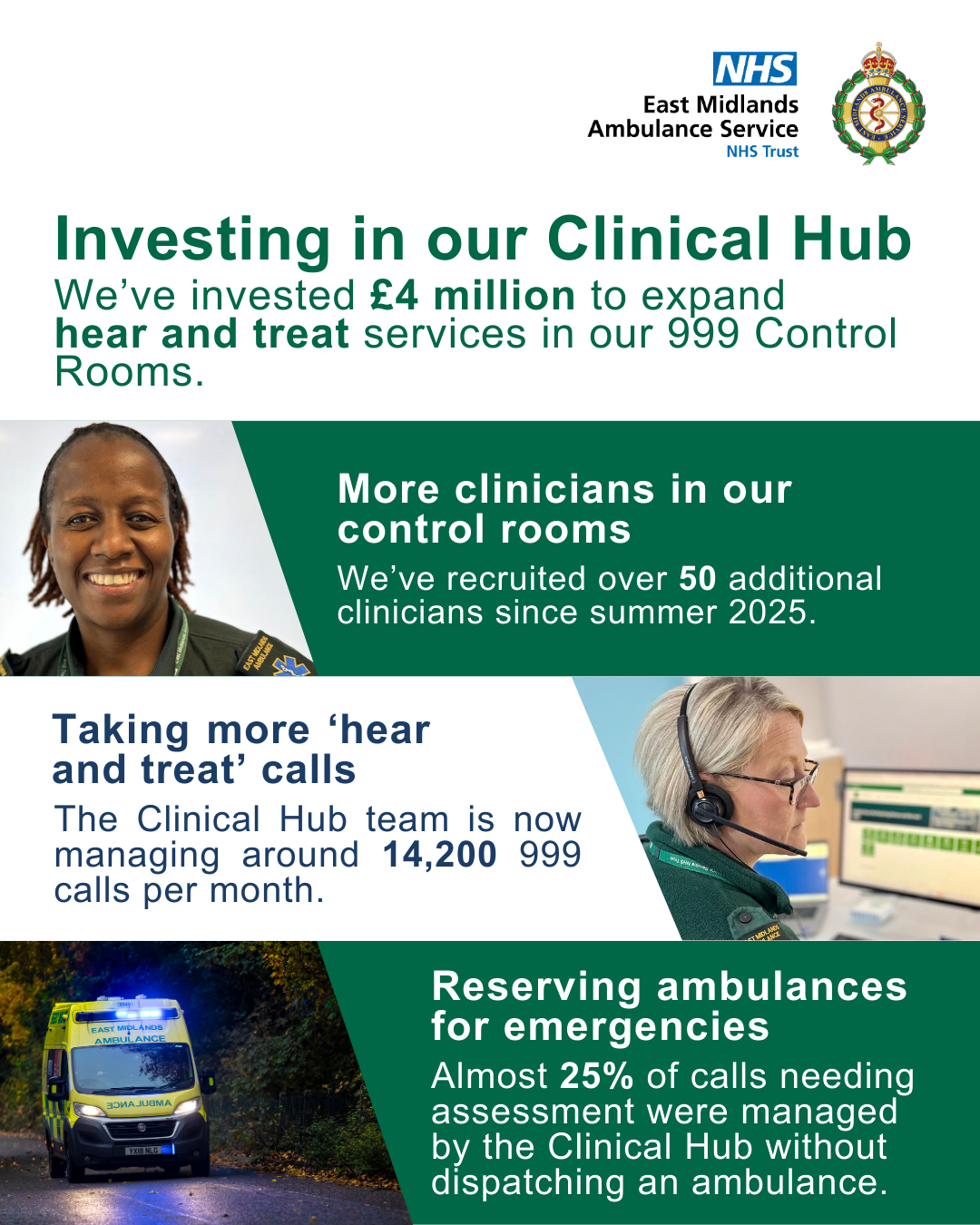
Thousands more people across our region are now receiving faster, appropriate care thanks to a £4 million investment in our Clinical Assessment Hub – staffed by experienced paramedics, nurses, and mental health clinicians, operating across multiple sites and supported by home-based clinicians.
By providing rapid assessments over the phone, the Hub helps ensure patients get the right care, in the right place, at the right time, while keeping our ambulances available for life-threatening emergencies.
Supporting patients with quicker access to the right care
Not every 999 call needs an ambulance, but every call does need quick, expert assessment. The Clinical Hub provides this by offering:
- clinical advice over the phone
- support to help patients manage their condition safely at home
- direct referrals to community or specialist NHS services
- urgent appointments arranged closer to home
- access to Clinical Assessment Services, where nurses and doctors can prescribe medication such as antibiotics.
This means more of our frontline ambulance crews remain available for the most life-threatening emergencies, when every second counts. It also helps reduce pressure on hospitals and supports the wider NHS at a time of extremely high demand.
Helping manage demand at the busiest times
During one of our busiest days in early January 2026, EMAS received more than 4,000 calls. Of them, around 2,500 calls required clinical assessment, with almost a quarter being safely managed remotely through the Clinical Hub without the need to send an ambulance.
On average, the Clinical Hub now manages more than 14,200 calls every month that previously would have required an ambulance response. Instead, these patients speak directly to an experienced healthcare professional who can provide treatment advice, make a referral, or arrange urgent community-based care.
Data from NHS England in November 2025 shows that around one in five of the 999 calls we received were managed safely by our Clinical Hub without sending an ambulance.
This helps ensure our crews can attend time-critical incidents such as cardiac arrests, heart attacks, strokes and breathing difficulties, while other patients receive alternative care that’s better suited to their needs and delivered in a timely manner.
Improving response times for life-threatening emergencies
The Clinical Hub is playing an important role in improving the speed of our ambulance response for people experiencing life-threatening emergencies.
By the end of 2025, average response times for serious conditions such as strokes, heart attacks and breathing difficulties (Category 2 calls) were significantly faster than during the same months in 2024 – including improvements of around 10 minutes in November and 22 minutes in December.
Building a stronger clinical workforce
The £4 million investment has enabled EMAS to expand and strengthen the team delivering critical clinical assessments.
Dr Steven Dykes, EMAS Clinical Director said: “The investment has allowed us to expand our existing Clinical Assessment team and introduce new specialist services within our control centres, including recruitment of over 50 additional clinicians since the summer.
“Our Clinical Hub brings together experienced paramedics, nurses, and mental health nurses who provide rapid clinical assessments over the phone. This is increasingly important as more people with clinically complex conditions seek help.”
Alongside the Clinical Hub expansion, EMAS:
- welcomed 47 Newly Qualified Paramedics at the end of 2025
- is receiving over 100 new ambulances to modernise and grow the fleet
- is enhancing how its clinical teams coordinate urgent care – including through our Critical Care Desk, to ensure seriously ill or injured patients receive faster, more coordinated care at home or in the community.
These developments strengthen our ability to care for critically ill patients and reduce pressure on hospitals.
Supporting the wider NHS system
The NHS 10-Year Health Plan describes a major shift in care delivery – from hospital-led to community-based.
Our Clinical Hub embodies this shift by offering high-quality clinical intervention earlier, closer to home, and without the delays associated with attending busy Emergency Departments.
By reducing avoidable ambulance dispatches and helping our patients receive the right care without going to hospital unnecessarily, EMAS is supporting the wider NHS at a time of sustained pressure.